For RIAs and their operations teams
Submit it once,
in good order.
The account came back. Now someone has to call the client again. Sluice validates and routes every account before the custodian can reject it — so it opens in good order the first time.
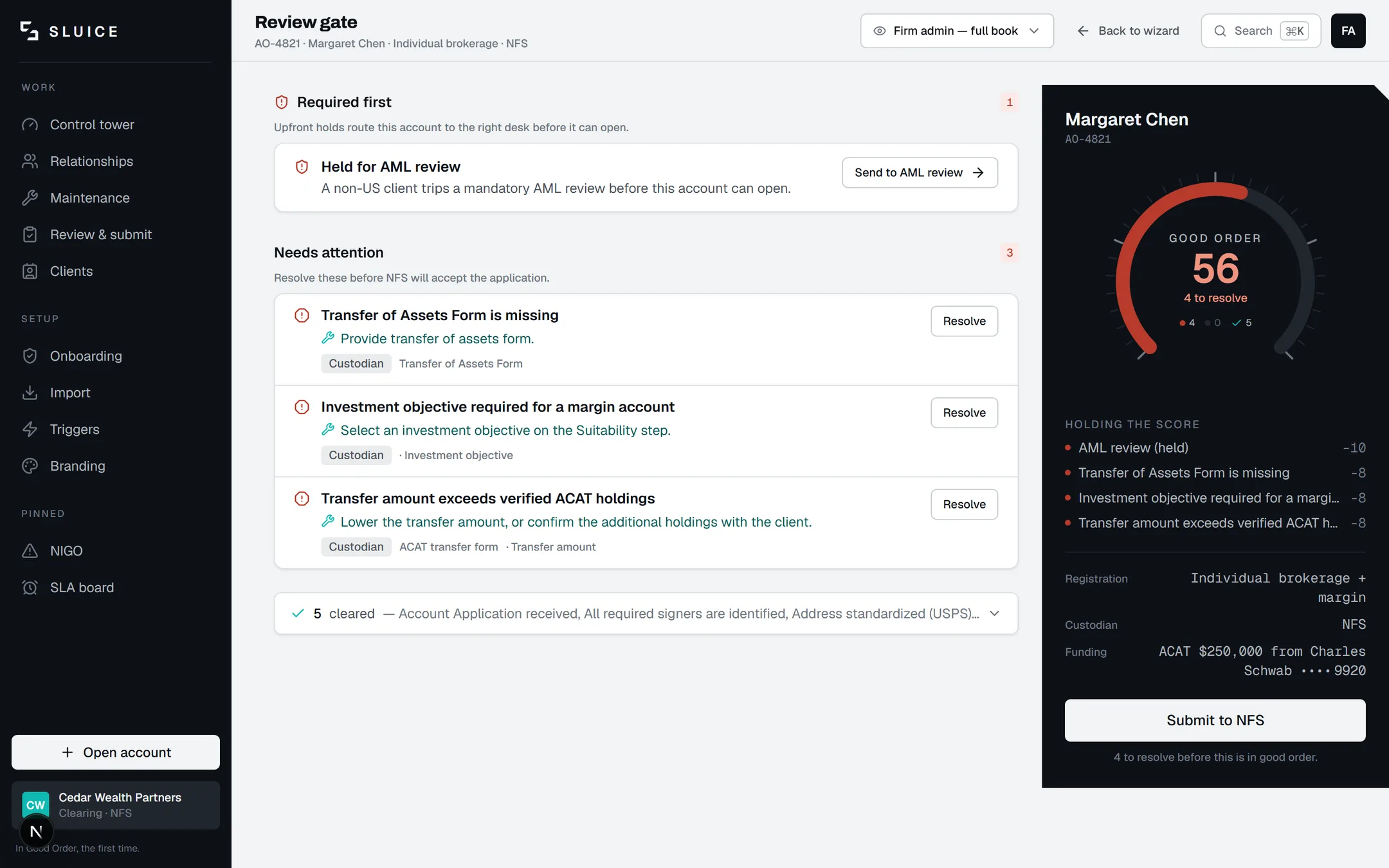
- Holding the score
- Non-US client · AML lockdown-10
- Funding ≥ $1M · supervisor-8
- OFAC screen · verifying-4
The reading
One score you trust at a glance. It reads 100 only when every check is affirmed and zero holds are open — never progress-theatre.
Who actually signs
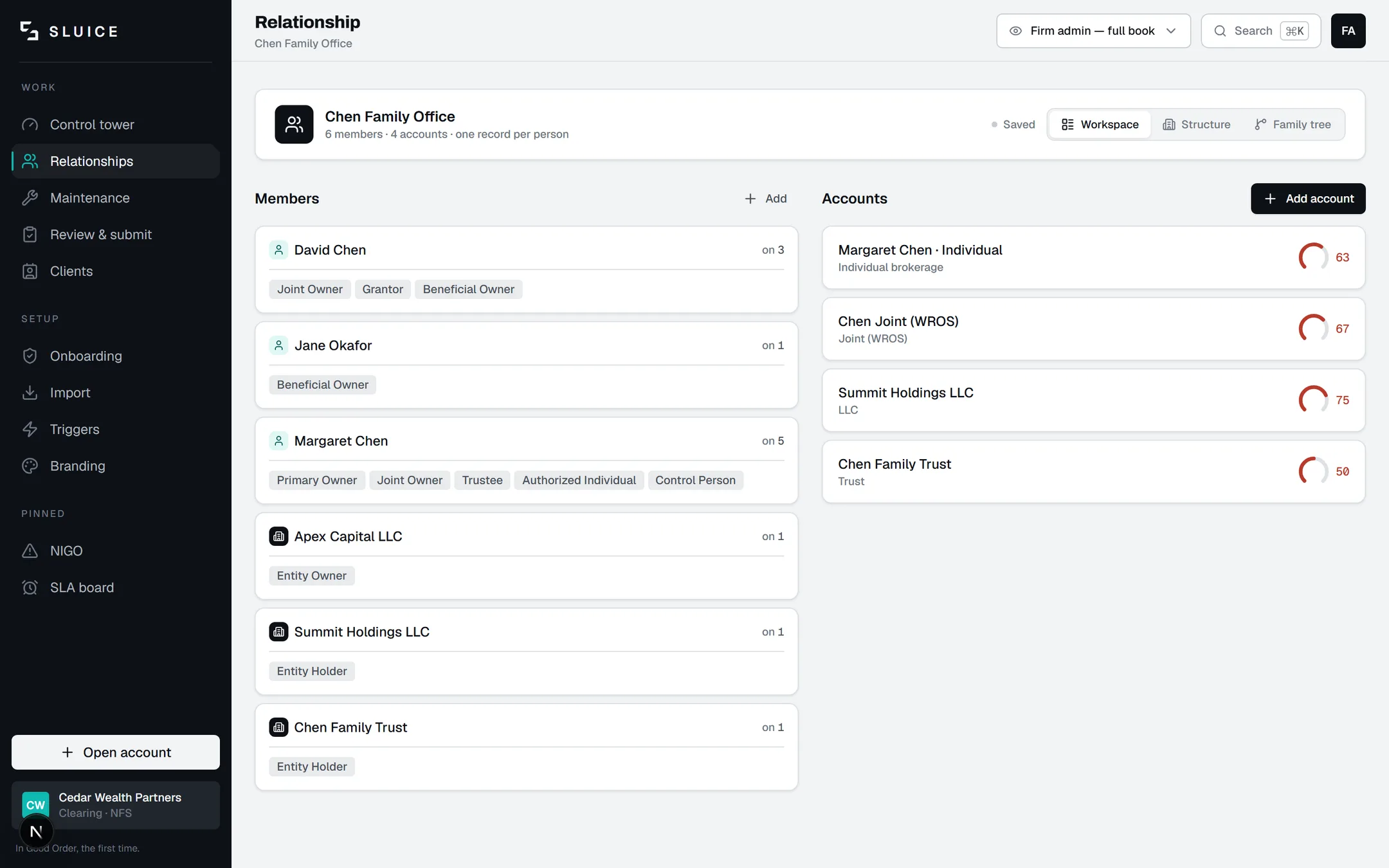
Beneficial owners are computed by multiplying ownership through every sub-entity, down to the natural people. CDD ≥ 25%, enforced.
- Non-US client · AML
- Funding ≥ $1M · supervisor
- OFAC · verifying
Decided up front
Rules trigger holds and reviews off the data — deterministically, before anything reaches the custodian.
Reads from and writes back to
- NFS · Fidelity
- Altruist
- Envestnet
- Wealthbox
- Dynamics 365
- DocuSign
- Salesforce
- Redtail
The whole account-opening surface
Everything between a signature and a funded account

Your book. Your systems. In good order.
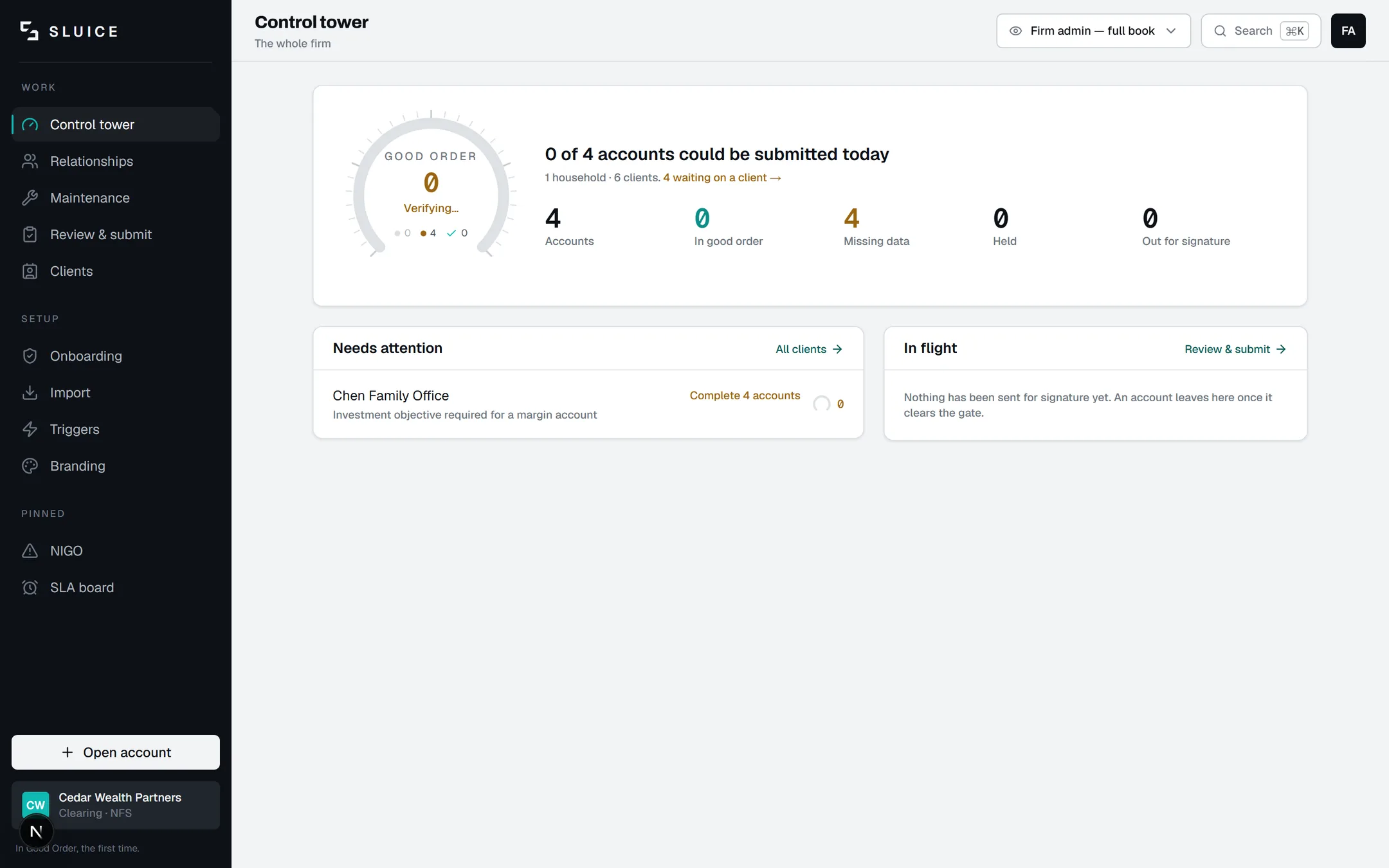
Sluice is not a system of record. It ingests a firm's client data, gets it into good order, pushes it back to the custodian and the CRM, and holds a working copy only while there is work to do.
Standards enforced · systems connected
Every rule is transcribed from a production account-opening system — the 39-type matrix, the entity beneficial-ownership bubble-up, the fail-closed gate. Not a greenfield guess.
The thesis
Quality control belongs upstream
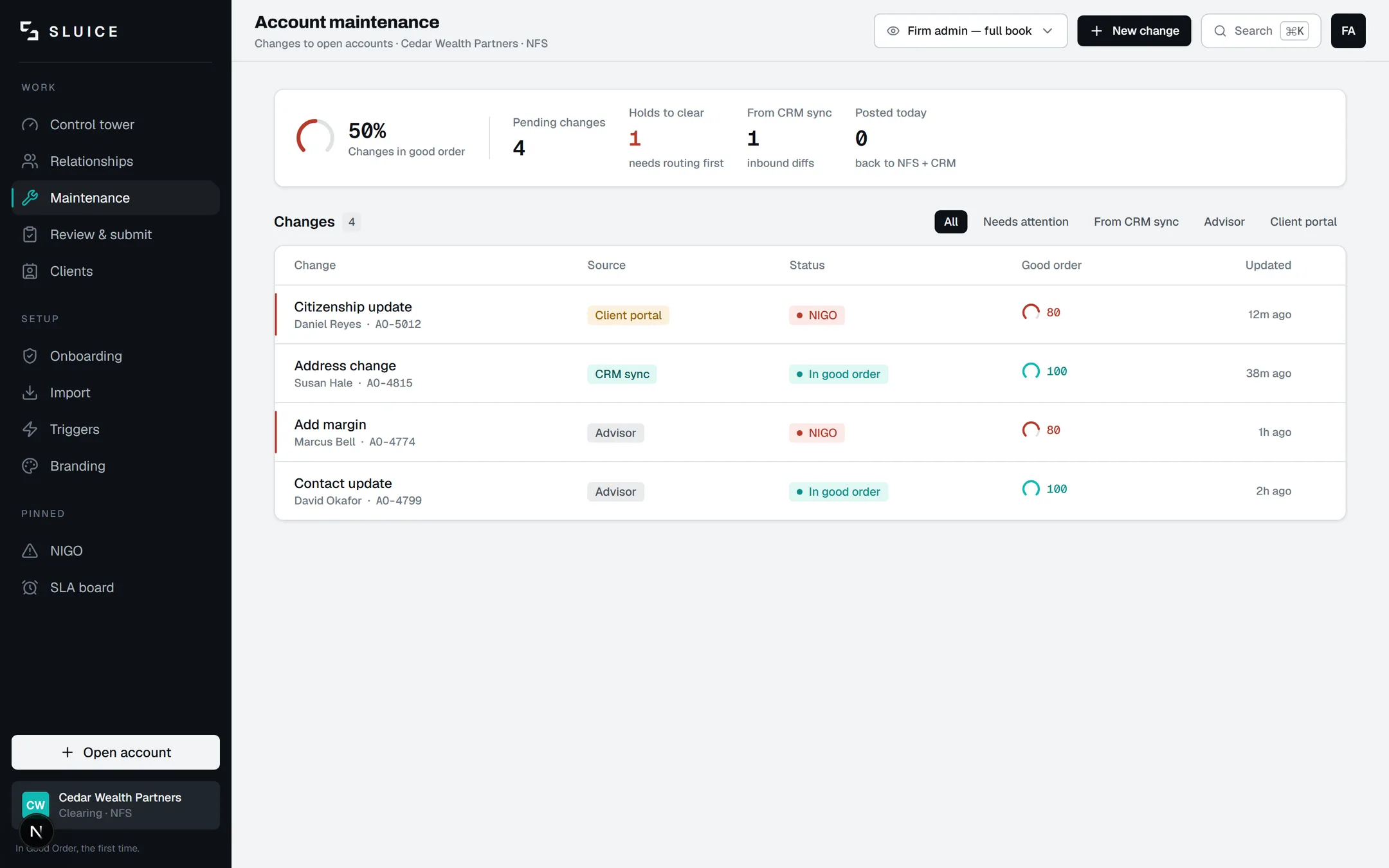
Everyone else cleans up NIGOs after the custodian rejects them. Sluice validates the documentation and the data before submission, so only business that is already in good order ever enters the flow.
The gate
One gate. Every account clears it before it moves.
Validation, screening and routing resolve at one checkpoint that has to say yes before anything moves — live in the browser as you work, and again on the server, where it is the answer that counts. Nothing reaches the custodian until the gauge reads 100.
The custodian's requirements and your firm's policy are checked before anything posts, and that check decides — it does not advise. The model only saves you the typing: it drafts a field from a document and flags a value that looks wrong, then hands both to the engine to rule on.
Quality control, moved to where it's cheap — the front of the flow. Caught up front, an issue is a field to fix; caught downstream, it's a rejected account and a phone call.
Everything the custodian will check, before they check it
The score is the send button's condition, not a dashboard ornament. Each line names the rule that is holding it and what to do about it, and the account cannot be sent while any of them stands.
Entity structures
Entity-of-entity, resolved to who actually signs
Signers bubble up through entity chains, and beneficial owners are computed by multiplying ownership through sub-entities. The regulatory invariants are enforced, not assumed.
- Signer bubble-up through sub-entities
- CDD owners at 25% or more, ownership multiplied
- Control-person invariant · ownership never exceeds 100%
Summit Ventures LLC
Account holder · FinCEN 31 CFR 1010.230
Firm policy
One custodian baseline. Every firm's policy on top.
A shared NFS baseline of 39 registration types, transcribed from the real custodian registry. Each firm layers append-only holds on top — tighten the floor, never lower it.
- 39 registration types, from the custodian's own registry
- Firm overlay is append-only: it can add a hold, never remove one
- Onboarding a firm is three inputs
Effective policy
NFS baseline + Cedar Wealth overlay
Where the model helps
The rules decide. The model just gets you there faster.
Nothing posts on a model's word. The engine checks every value against the custodian's registry and your firm's policy, and that verdict is the product. What the model does is spare an advisor the typing: it drafts a field from a document or a CRM record, flags a value that looks wrong, and hands both to the engine to rule on.
Driver's licence · page 1
Built for compliance
Evidence-grade by design
One firm never sees another
Every record is row-locked to your firm in the database engine itself — isolation is enforced below the application, not filtered above it.
The trail cannot be rewritten
The audit trail, signed baselines and verdicts are tamper-evident, hash-chained ledgers. History is added to, never rewritten.
Tax IDs never stored in the clear
Tax IDs are envelope-encrypted and vaulted. Screens, logs and the audit ledger carry last-four only — a leak of any of them leaks no identifier.
Nothing posts on a model's word
Models propose; the deterministic engine verifies every value against custodian and firm rules. Your data is never used to train models.
In good order, the first time.
Built for the front office that can't afford a NIGO — validated and routed the first time, or held before it can do damage. That's the whole product.